

Best Warmy Alternative For Email Deliverability
You went to check what Warmy costs, and the pricing page handed you that infamous “Book a Demo” button instead of a number.
That’s usually the same moment people start shopping for a Warmy alternative. Warm-up is a background process you pay for every month, on every mailbox, indefinitely, so it’s hard to budget for when you can’t see the price.
Below, we’ll cover what Warmy.io does, why teams move off it, and five tools worth comparing against it at their real published cost.
What is Warmy.io and how does it work?
Warmy.io is an email deliverability platform primarily built around automated warm-up. It connects to your mailbox, then sends and receives messages across a network of other Warmy users’ inboxes, opening them, replying to them, and pulling them out of spam so that Google and Microsoft see steady positive engagement coming from your email domain.
Its AI layer, Adeline, adjusts daily volume per domain in real time instead of following a fixed ramp-up schedule. And all incoming warm-up mail auto-archives after roughly 20 minutes, so your inbox stays usable.
Around the warm-up sits a wider suite, with seed lists, deliverability insights, a Google Postmaster integration, and an API.
And in all fairness, most users are happy with this tool, since Warmy holds 4.8 out of 5 on G2 across more than 520 reviews, with customer support scoring especially well.
Why teams start looking for a Warmy alternative
The main trigger is usually the pricing model.
Warmy charges per mailbox, which is manageable at one or two but compounds fast at ten, and is priced well above other similar tools. And unlike a setup fee, email warm-up has to keep running for as long as the mailbox is sending. It’s a permanent line item, multiplied by every inbox you own.
The second trigger is much newer. As of August 2026, Warmy’s pricing page shows no prices at all. It simply lists three categories, B2B sender, B2C sender, and Custom plan, each with a “Book a Demo” button.
Beyond cost, a few themes repeat across Warmy.io reviews on G2 and Capterra: controls like template warm-up and language targeting sit behind the higher tiers, accounts occasionally disconnect silently while billing continues, the dashboard runs quite thin on analytics, and results on Microsoft 365 are less consistent than on Google Workspace.
Before you blame the tool, check SPF. Every sending service you connect adds another lookup to your SPF record, and once you pass ten, the whole record fails — silently, with no error visible anywhere, and no warmup tool can fix that:
Free SPF Record Checker
Look up any domain’s SPF record, validate every mechanism, and see the real DNS-lookup count — including every nested include. Runs entirely in your browser.
What this checks (and why the lookup count matters)
SPF (Sender Policy Framework) is the DNS record that lists which servers may send email for your domain. If it’s missing, broken, or over the limit, receivers can’t verify your mail — and your campaigns land in spam.
- The 10-lookup limit is the #1 killer. SPF allows a maximum of 10 DNS lookups per evaluation. Every
include:you add pulls in that provider’s includes too. Go over 10 and SPF returns permerror — it fails for mail you actually authorised. - Most free checkers only count the includes they can see in your record. This one follows every chain recursively and shows what each include really costs.
- We also flag
+all, missingall, the deprecatedptrmechanism, duplicate SPF records, dead includes, and mechanisms placed afterallwhere they’re silently ignored.
Lookups are performed from your browser via Cloudflare’s public DNS-over-HTTPS resolver. Nothing is logged or stored by this tool.
How to fix the most common SPF problems
- Too many DNS lookups. Drop includes for tools you no longer use, replace an
include:with the provider’s publishedip4:ranges where they’re stable, or use an SPF flattening service. Check the include tree above to find the expensive ones. - Two SPF records. You may publish exactly one. Merge the mechanisms from both into a single
v=spf1 … ~allrecord and delete the other. - Mail still failing SPF. SPF checks the envelope sender (Return-Path), not the From header a recipient sees. A tool sending “from” your domain with its own Return-Path passes SPF on its domain — which is why DKIM and DMARC alignment matter too.
- Ready to tighten. Move from
~allto-allonly after DMARC reports confirm every legitimate sender is authorised.
Warmy.io alternatives compared at a glance
Six Warmy.io alternatives below, including Warmy itself for reference. Every price comes from the vendor’s own pricing page, checked in August 2026. Warmy’s row is the exception, because there’s nothing published to quote.
| Tool | Starting price | How it’s priced | Best for | Free trial |
|---|---|---|---|---|
| Warmy.io | Not published | Per mailbox, volume-based | B2B and B2C warm-up in one suite | 7 days |
| MailToaster | $29 /account/mo | Flat, per email account | Straightforward warm-up and reputation | 7 days |
| MailReach | $25 /mailbox/mo | Per mailbox, sliding to $16 | B2B teams past 20 mailboxes | Free spam tests only |
| Folderly | $96 /mailbox/mo | Per mailbox, annual billing | Enterprise senders who want it managed | Demo only |
| InboxAlly | $149 /mo | Per sender profile | Fixing an active reputation problem | 10 days |
| GlockApps | $85 /mo ($59 annual) | Per plan, by credits and accounts | Diagnosing why placement is bad | Free plan |
The 5 best Warmy.io alternatives for email warmup
Here’s our top Warmy.io alternatives for email warmup, ordered by how closely each one replaces what Warmy does, not by price. The last two sit further from a like-for-like swap, and they’re here because plenty of people shopping for warm-up actually need what those two do instead.
MailToaster
MailToaster is an automated email warm-up service designed to build, protect, or repair your sender reputation so more of your emails land in the inbox. You connect a Gmail, Outlook, or other provider account in just a few clicks, and warm-up starts right away. No migration, no technical setup.
It costs $29 per email account per month, with 10% off annual billing and a 7-day free trial, and there’s no volume tier to negotiate and no demo to sit through — that number is the full price.
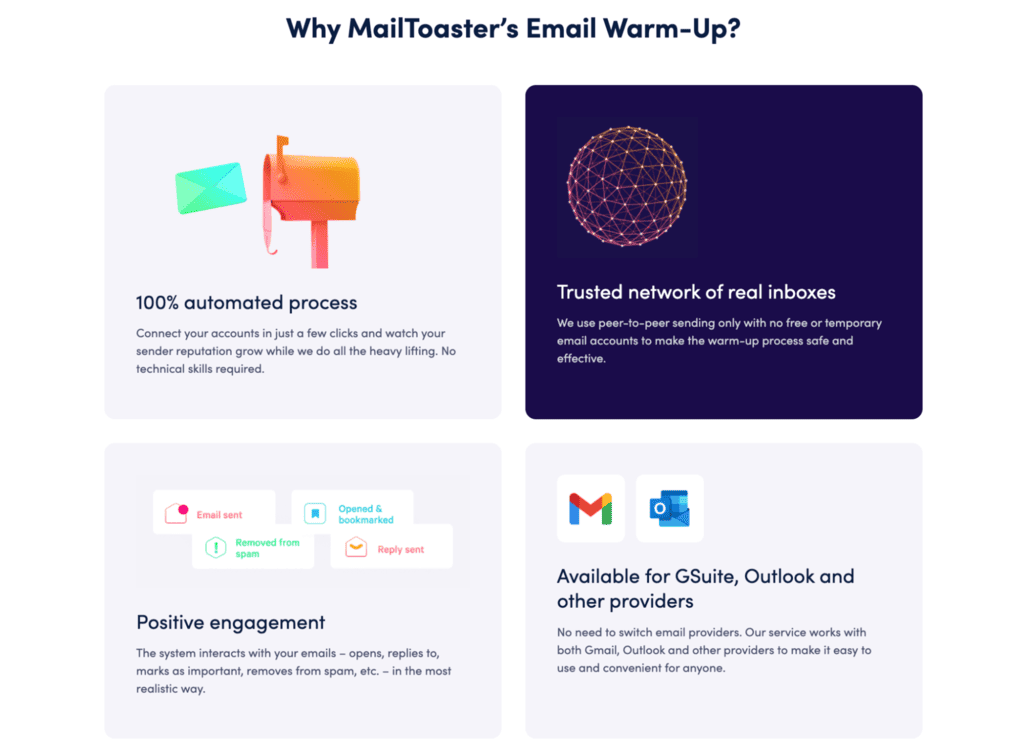
The warm-up network is peer-to-peer and built only from real inboxes, with no free or temporary accounts padding the numbers, which is the failure mode that quietly ruins cheap warm-up. It opens your emails, replies to them, marks them as important, and pulls them out of spam the way a real correspondent would.
Two warm-up profiles cover the two main jobs:
- New Email Account builds reputation from zero
- Reputation Protect holds an established sender steady once it’s at volume.
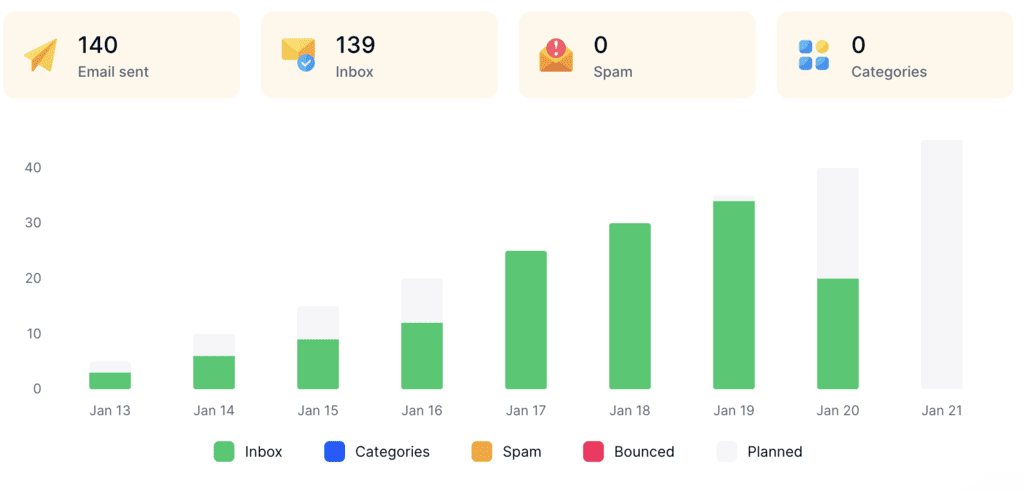
It also checks your SPF, DKIM, and DMARC records automatically, and reports what landed in the inbox, spam, or a Promotions tab, which is the actual number that maps to inbox placement.
| “It’s a reliable tool and I have found that my deliverability compared to other tools is much better.” Samuel Klein, Founder & CEO |
|---|
MailReach
MailReach starts at $25 per mailbox per month and slides down as you add inboxes: $19.50 from 6 to 20, $18 from 21 to 50, and $16 above that, with another 20% off annual billing. Fifty mailboxes work out to roughly $900 a month.
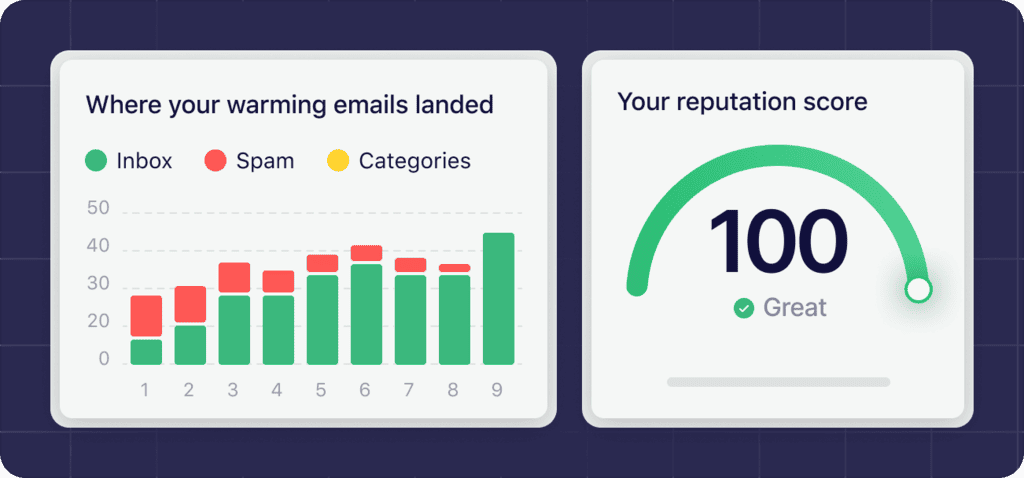
Its warm-up network runs to 30,000+ Google Workspace and Office 365 inboxes, and every plan includes 20 spam test credits, so placement testing isn’t a separate purchase. Agencies get per-domain reputation tracking, Slack alerts when a score drops, and a full API.
The trade-off is its focus, given its network is built exclusively for B2B senders. So if you’re warming consumer-facing Gmail or Yahoo mail, Warmy’s separate B2C plan is genuinely the better fit.
Folderly
Folderly sits at the premium end, with a starting rate of $96 per mailbox per month for 1-9 mailboxes, with a 20% discount on the annual plan. Volume tiers of over 100 mailboxes are custom-quoted on a demo call. And keep in mind that Inbox Insights, its placement and DNS testing product, is priced separately: free for 2 tests a month, $79 a month for 100.
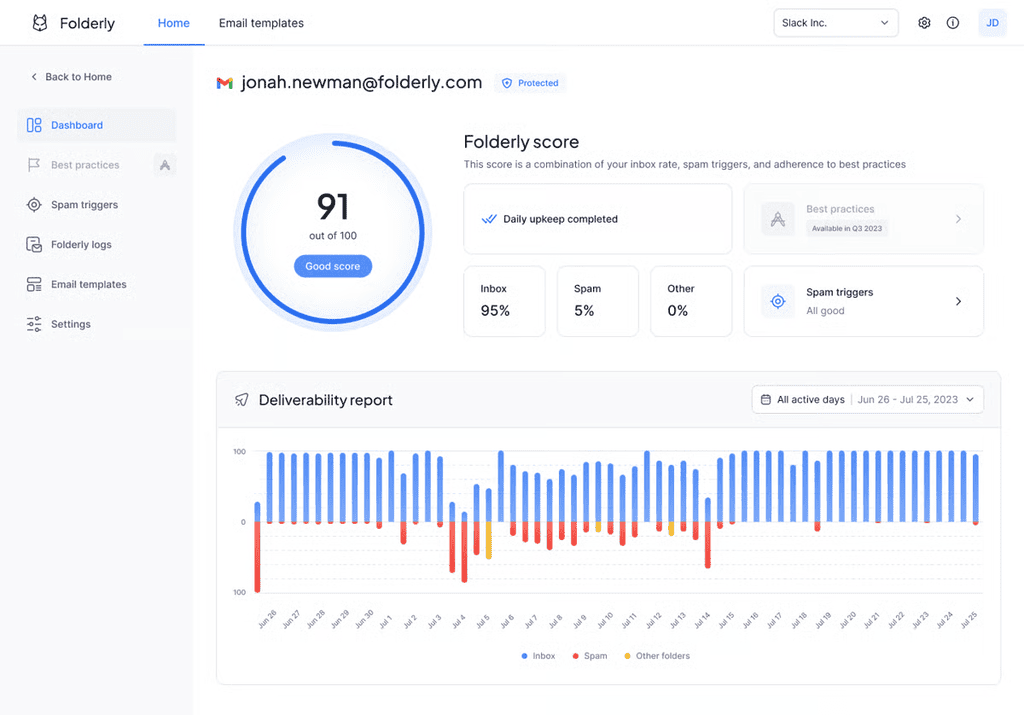
What you’re buying is closer to a full deliverability service than a simple warm-up or inbox placement tool. It comes with audit-led deliverability covering content, authentication, and sending infrastructure, with human specialists involved rather than a dashboard you’re left alone with. That suits enterprise senders who would rather hand the problem over, but everyone else pays a lot for capability they won’t ever use, and there’s no self-serve checkout.
InboxAlly
InboxAlly is a lightweight email deliverability tool that starts at $149 a month for one sender profile and 100 seed emails a day. Plus is $645 for five profiles and 500 seeds, Premium is $1,190 for ten profiles and 1,000 seeds, and there’s a 10-day free trial with no card required.
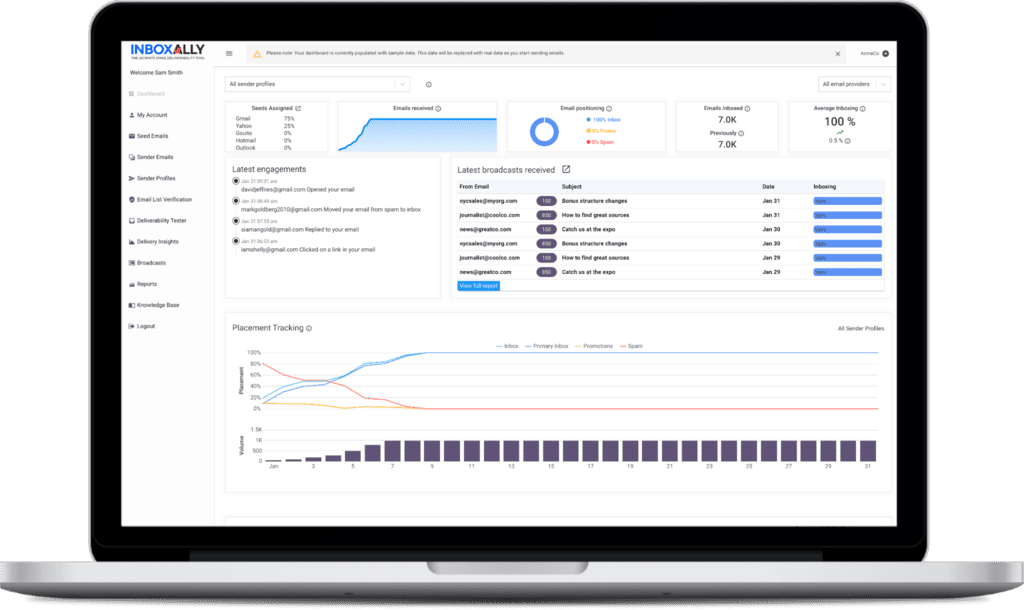
Dedicated seed inboxes run seven engagement actions against your mail on a schedule you set, opening, replying, and lifting messages out of Spam and Promotions, which gives you direct control over the signal. Adaptive autowarmup, ML-based sender scoring, full REST API, and a dedicated CSM come with every tier rather than being gated to the top one.
It’s built for senders with an active reputation problem and the budget to fix it quickly, newsletter and ESP senders included. The catch is its pricing, which lands at roughly five times a per-mailbox warm-up tool like MailToaster, and the sender-profile model gets expensive fast across many inboxes.
GlockApps
GlockApps covers the diagnostic half of what Warmy bundles and doesn’t do warm-up at all. You get seed-list spam score testing across providers, DMARC analytics, blacklist and uptime monitoring, and Google Postmaster data for real-time spam monitoring.
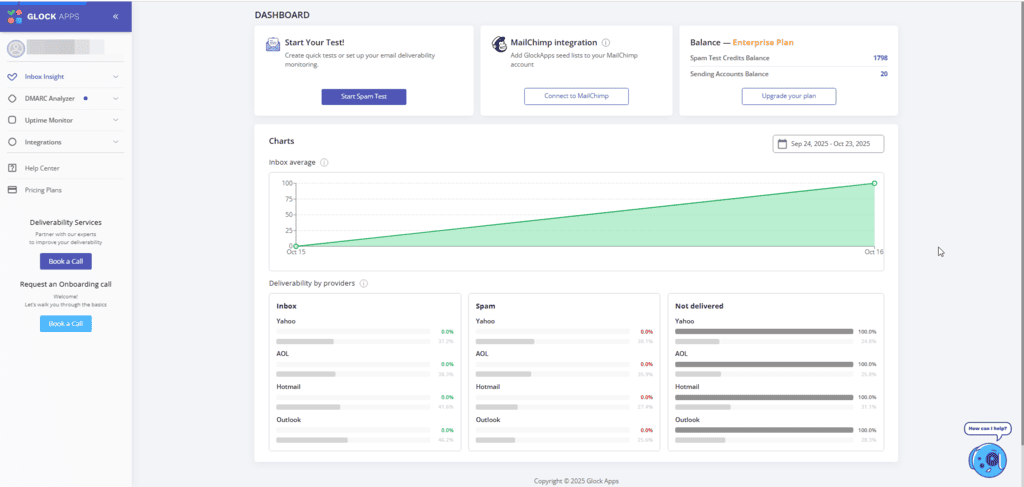
Plans run $85 a month for Essential (one sending account, 30 spam test credits), $142 for Growth (10 accounts), and $185 for Enterprise (20 accounts). Annual billing cuts that to $59, $99, and $129 and raises the credit allowance sharply, and there’s a free tier with two test credits.
Use it when you already know placement is bad and need to find out why, be it authentication, content, infrastructure, or a blacklist. Since it won’t build sender reputation, most teams run it alongside a warm-up tool rather than instead of one.
On the other hand, if you’re looking into email warm-up, you’re probably already using or looking for an outreach automation tool, and those will always have built-in analytics that cover this natively (more on that shortly).
Warmy.io pricing in 2026
As previously mentioned, Warmy.io pricing is no longer published. As of August 2026, the page shows B2B sender, B2C sender, and Custom plan, each behind a “Book a Demo” button, with volume-based pricing described but never quantified. The 7-day free trial with no credit card is still there.
The best available numbers are third-party sources, which agree that tiers are roughly $49 per mailbox per month for Starter, rising through $129, $189, and $279 to about $429 for Platinum. Treat those as indicative rather than current, since the tier structure they describe no longer appears anywhere on Warmy’s official pages.
Run the multiplication anyway. At the old Starter rate, ten mailboxes came to about $490 a month, or $5,880 a year, for something that runs entirely in the background. The same ten mailboxes on MailToaster cost $290 a month at a fixed, self-serve price.
Already paying for an outreach platform?
Email deliverability is crucial for any team running outreach at scale, but those teams will have other software in their stack, and this is where it gets tricky. If you already have an email marketing platform, for instance, you can simply get MailToaster for $29/month per email account without spending thousands of dollars a year.
And if you’re on the market for an outreach platform, Reply.io starts at just $49/user/month (about the same as Warmy) and completely removes the need for a warm-up tool like Warmy.
Reply is an AI outreach platform that has the entire deliverability suite with MailToaster baked into the product, a Google Postmaster integration, sending volume controls, email authentication setup and monitoring, and more.
While that deliverability toolkit runs in the background, Reply also helps you find targeted leads through its 1 billion+ B2B database, enrich their profiles with additional context, and then launch personalized outreach campaigns across email, LinkedIn, calls, and more.
How to choose the best Warmy.io alternative
Five things will really change the outcome when choosing the best warmy io alternative, while the rest is a feature list:
- How you’re charged, and whether it’s public → per mailbox, per user seat, or per sender profile. The model matters more than the headline number, and a price you can plan around without a sales call counts for something.
- Network quality → warm-up only works if the inboxes opening and replying to you are real, established accounts. Networks padded out with free or disposable addresses produce signals that Google and Microsoft largely discount.
- Provider coverage → Google Workspace, Microsoft 365, and custom SMTP all behave differently. Check the tool is strong on whichever one you send from.
- Scope → some tools warm up, others also test placement and monitor reputation, but few do both well. With B2B software, it’s always best to consolidate processes under one roof.
- Reporting → “Deliverability improved” is not a meaningful report you can work with. You want inbox versus spam versus Promotions, per mailbox, over time.
Final thoughts
When choosing the best Warmy.io alternative, focus on two key things — exactly how you’re charged, and whether the warm-up network is built from real inboxes. Feature lists mostly wash out, because every tool here sends, opens, replies, and rescues from spam. What differs is the price, and whether you can find it out without a sales call.
Run one mailbox on a trial before committing a whole domain. If a flat published price and a real peer-to-peer network is what you want from a Warmy alternative, MailToaster warms any Gmail or Outlook account for just $29 a month, with inbox-versus-spam reporting and authentication monitoring in real time.
FAQ
How much does Warmy.io cost in 2026?
Warmy doesn’t publish prices anymore. The pricing page lists B2B sender, B2C sender, and Custom categories, all of which require a demo call. Third-party data from G2 and Capterra puts the historical range at roughly $49 to $429 per mailbox per month, though the tier structure behind those figures is no longer displayed.
Is there a free alternative to Warmy?
Not for warm-up itself. A warm-up network needs real, maintained inboxes, and those cost money to run, so free tools here are either trials or diagnostic. GlockApps has a genuine free tier for spam testing, and most warm-up tools, MailToaster included, run a 7-day trial.
Can I switch to a Warmy alternative without hurting my sender reputation?
Yes, provided you don’t leave a gap. Connect the new tool and confirm it’s sending before you disconnect Warmy, so warming continues uninterrupted. Reputation decays when sending stops, not when the vendor changes.
Do I still need warm-up once my domain is established?
Yes, at a lower intensity. An established domain that keeps sending cold outreach is still scored on engagement every day, and one bad week of low replies or spam complaints moves the number. Maintenance warm-up puts a floor under your email address reputation rather than building it from scratch.